
The effect of metallicity evolution on BBH merger properties in IllustrisTNG
Johns Hopkins University
Advisors: Floor Broekgaarden, Lieke van Son, Emanuele Berti
Metallicity (the ratio of hydrogen to elements heavier than helium) is a crucial parameter in stellar and binary formation and evolution. It determines the formation efficiency of massive stars which are progenitors of neutron stars (NS) and black holes (BH), and affects the strength of stellar winds, mass loss from the star of binary system, and supernova kicks which can unbind a binary system. Binary black holes (BBH) are particularly affected by metallicity (most crucially iron content), and form most easily in low metallicity environments.
Over cosmic time, the universe has been gradually enriched with metals from the lifecycle of stars. Therefore, in order to study low metallicity environments that are favorable for BBH formation, it is important to study early (high redshift) star formation. Due to the effect of delay times (the time from formation of a BBH to its merger, which can take several million, to tens of billions of years), many BBH observed today by the gravitational wave detectors LIGO/Virgo/KAGRA likely originated from stars formed at high redshifts. Future gravitational wave (GW) detectors will be able to observe GW signals at high redshifts, opening opportunities to place constraints on the formation and merger rates of BBH systems. This, in turn, will allow for greater constraints on low metallicity, high redshift stellar and binary evolution.
For my current project, I am probing the effect of metallicity on the formation and merger rates and properties of BBHs over cosmic time. As observation of high redshift galaxies is challenging, for a more complete analysis of the effect of metallicity on the BBH merger population, I use data from cosmological simulations. While cosmological simulations have many assumptions and are limited by resolution, by comparing different cosmological simulations with different assumptions, it is possible to constrain the parameter space of the BBH population. Currently, I use the gravo-magnetohydrodynamical simulation IllustrisTNG, and intend to expand to other simulations including the CAMELS cosmology project.
I use metallicity and star formation rate data from IllustrisTNG in combination with the rapid population synthesis code COMPAS in order to calculate the merger rate and primary mass distribution of stellar mass BBHs in IllustrisTNG using an analytical model for the metallicity-dependent star formation rate density (SFRD). The use of a physically motivated analytical model will allow for direct comparison with other cosmological simulations and observational data.
Past projects

Wind mass-transfer in low-mass binaries
CIERA, Northwestern University
Advisors: Meng Sun, Vicky Kalogera, Zoheyr Doctor
Wind Roche-lobe overflow (WRLOF) is a mass-transfer mechanism in binary systems in which the stellar wind transfers material from the more massive donor star to the accretor star. It occurs when the wind acceleration zone (the region around a star within which its stellar wind is gravitationally confined) expands to fill the Roche-lobe, and the material which is carried by the wind escapes from the donor star and is captured by the accretor star. This is possible in the case of slow, dense, dust-driven winds.
WRLOF has not yet been modeled using detailed binary simulations for a large parameter range, but it may be applicable to explaining a number of non-standard types of stars which are accepted to form due to mass-transfer, but cannot be explained using standard mechanisms of mass-transfer. This includes blue lurkers, carbon-enhanced metal-poor (CEMP) stars, and blue stragglers. We use the detailed binary evolution codes MESA and POSYDON to model WRLOF in the full stellar mass-orbital period parameter space of low-mass binary systems to probe whether the application of WRLOF in models can explain the observed populations and characteristics of blue lurkers.
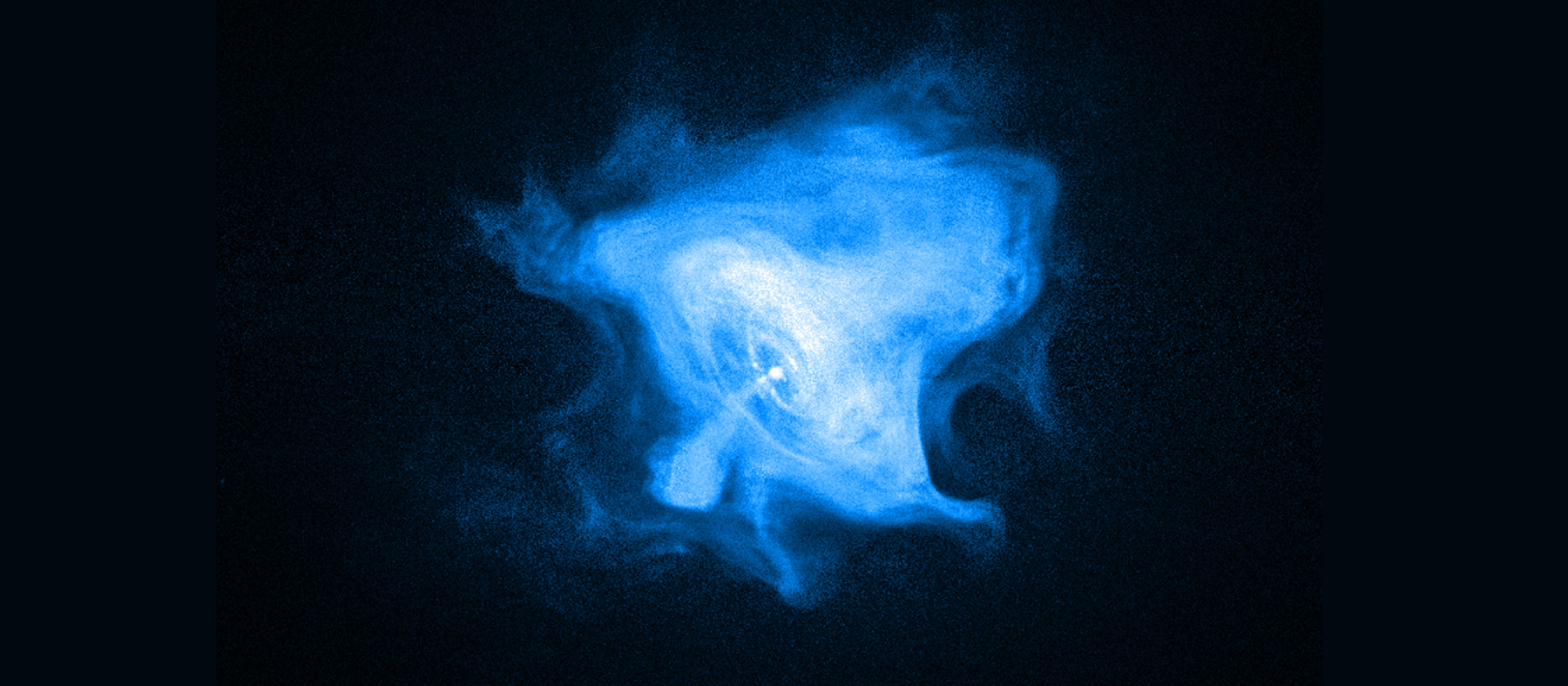
Pulse-to-pulse variation in the X-ray emission of the Crab Pulsar
Haverford College
Advisor: Andrea Lommen
Pulsars are a type of highly magnetized, rapidly spinning neutron star. Their emission mechanisms are not well understood, especially in the X-ray regime, as we receive very few photons from each rotation (or "pulse") of the pulsar. This is a major obstacle to studying the pulse-to-pulse variation in the pulsar emission which could constrain underlying emission mechanisms of X-ray photons.
The Crab Pulsar (PSR B0531+21) is an extremely bright pulsar, which emits sufficient X-ray photons per pulse for it to be possible resolve the pulse shape when taking the sum of only a few pulses. It is therefore possible to probe the pulse-to-pulse variation in the X-ray emission. We use X-ray pulsar timing data from the Neutron star Interior Composition Explorer (NICER), an International Space Station payload, to study the pulse-to-pulse intensity modulation of the Crab Pulsar.